Why You Were Cold in Your Sleeping Bag - and How to Sleep Warm as Nights Turn Cool
Quick Answer: You were cold because heat left downward into the ground and because you went to bed with nothing in the tank - not because the bag failed. Late-summer nights routinely drop 30 degrees below the daytime high, especially under clear skies. Fix it with insulation underneath you, a dry dedicated sleep layer, a hot water bottle, food before bed, and a hat. The pad matters more than the bag.
The day was 85 and gorgeous, so you packed like summer. At 3am you were curled in a ball doing math on how many hours until sunrise. Every camper gets this night exactly once - because the fix, it turns out, is mostly free and entirely learnable.
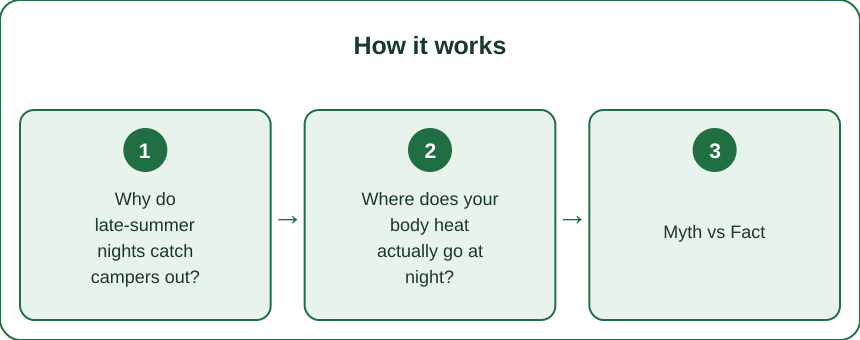
Why do late-summer nights catch campers out?
Because the gap between afternoon and 4am is at its most deceptive in late August.
Clear skies are heat drains. The bright high-pressure weather that makes perfect camping days also makes cold nights: with no cloud blanket, the ground radiates its heat straight to the sky after sunset, and air temperature falls fast and keeps falling until just before dawn. A 30-degree swing between the daily high and the pre-dawn low is routine, and in dry air, in a valley bottom, or at elevation it can be more - valleys collect cold air like sinks.
The season has quietly turned. Nights lengthen noticeably by late August, giving the ground more hours to shed heat than in July. The calendar says summer; the overnight low is already rehearsing October.
Your gear is running summer settings. The airy tent with maximum mesh, the light bag you loved in July, sleeping in the shirt you hiked in - each choice was right for the season that is ending.
And bag ratings mislead. The temperature printed on a sleeping bag is typically closer to a survival threshold than a comfort promise. A 40-degree bag does not mean cozy at 40 degrees - for most people, and especially for cold sleepers, comfort sits 10 to 15 degrees above the rating. If the forecast low touches the rating number, plan on every trick in this article.
Where does your body heat actually go at night?
Four exits, and campers consistently guard the wrong one.
Down, into the ground - the big one. Earth is an enormous heat sink, and the insulation under you does most of the protecting. Worse, the bag insulation you are lying on is compressed flat and does almost nothing - loft is what insulates, and crushed loft has none. This is why the sleeping pad is the most important item in the sleep system: its insulation does not compress away. A thin summer pad over cooling ground is the single most common cause of cold nights, and doubling it with a cheap foam pad underneath transforms things.
Out, on the air - convection. Drafts through mesh panels, a bag left half-unzipped, and wind under the fly all strip the warm air layer your body worked to build. Pitch with the low side to the wind, close the big vents partway, and cinch the bag.
Off your head and neck. An uncovered head in a cool tent is a steady leak all night. A knit hat and a cinched hood or a buff around the neck close it. It is the cheapest warmth per ounce in your pack.
Through dampness - evaporation. The clothes you wore all day carry sweat and humidity, and damp fabric pulls heat as it dries. Hiking-shirt-to-bed is one of the most common errors in camping, and it is fully fixable with one dedicated dry layer.
Rank your fixes in that order - ground first, drafts second, head third, dampness fourth - and you will solve the night for the price of a foam pad and a hat.
Myth vs Fact: Sleeping Warm Outdoors
Myth: Sleeping with fewer clothes in the bag is warmer. Fact: This campfire classic is backwards. Dry insulating layers add warmth exactly like extra bag loft. The grain of truth it grew from: damp or compressing-tight clothes are bad. Dry, loose base layers are unambiguously good.
Myth: A thick cotton hoodie is a good sleep layer. Fact: Cotton holds moisture and chills you as it slowly dries. Fleece, wool, or a synthetic base layer insulate even slightly damp. The hoodie can be a pillow.
Myth: A nightcap of something strong warms you up. Fact: Alcohol opens blood vessels at the skin, which feels warm for twenty minutes while actually accelerating heat loss - then it fragments your sleep in the coldest hours. Save it for lunch on the last day.
Myth: Breathing inside the bag helps. Fact: Every exhaled breath carries water vapor, and inside the bag it condenses into the insulation, deadening loft night after night. Nose and mouth stay outside the bag; cover your face with a buff instead.
Myth: The bag rating is a comfort promise. Fact: It is closer to a lower limit. Add 10 to 15 degrees for comfort, more if you run cold - and remember the pad rating matters just as much, because the coldest surface you face all night is the one you are lying on.
What is the routine that guarantees a warm night?
Warmth at 3am is manufactured between dinner and lights out. The sequence:
Eat real food before bed. Your sleeping bag does not make heat - you do, and calories are the fuel. A dinner with fat and carbohydrate, or a bedtime snack like nuts, cheese, or a peanut butter wrap, stokes the overnight furnace. Cold nights after light dinners are not a coincidence.
Do two minutes of warm-up, not a workout. Jumping jacks or a brisk walk until you feel warm - not sweaty - just before getting in. You are pre-heating the body that will pre-heat the bag. Going to bed cold means the bag preserves cold just as faithfully as it would preserve warmth.
Boil water, make a bottle. A hard plastic bottle filled with hot water, in a sock, dropped in the footbox twenty minutes before you get in. This is the most luxurious cheap trick in camping. Confirm the lid is tight, always.
Change everything. Dedicated dry base layer, dry socks reserved only for sleep, hat on. The sleep clothes live in the bag’s stuff sack and are never worn by day - that discipline is what keeps them dry.
Manage the space. Stuff tomorrow’s clothes into the bag’s dead air around your legs - less air to heat, pre-warmed clothes at dawn. Crack a vent slightly rather than sealing the tent airtight, so breath moisture leaves instead of condensing on everything.
And go before you sleep. A full bladder is a small heat cost all night and a guaranteed freezing trip at 2am. Handle it at bedtime, and keep shoes and a light where your hand can find them - the fast trip is the warm trip.
FAQ: Cold-Night Camping Questions, Answered
Why was I cold even though my sleeping bag was rated for the temperature?
Bag ratings run close to survival limits, not comfort, and the bag under you was compressed flat and doing nothing. Add 10 to 15 degrees to the rating for comfort, and put your money and attention into the pad beneath you.
What should I wear to sleep when camping?
A dry base layer kept only for sleeping, dry socks, and a knit hat. Loose fleece or wool on top if it is properly cold. Never the clothes you hiked in - daytime fabric carries moisture, and moisture is cold.
How much colder does it get at night in late summer?
A 30-degree drop from the afternoon high is routine under clear skies, and valleys and higher elevations run colder still. Check the overnight low for the campsite, not the town nearby, and pack for that number rather than the daytime forecast.
Does putting a blanket under you really help more than over you?
Often, yes. Compressed insulation under your body barely works, and the ground steals heat all night by conduction. Extra layers underneath - a foam pad, a folded blanket - frequently beat the same layers on top.
TL;DR:
- Clear late-summer skies drop nights 30 degrees below the daytime high - pack for the 4am number.
- Heat leaves downward first: the pad and what is under you matter more than the bag on top.
- Dry dedicated sleep layers, a hat, food before bed, and a hot water bottle manufacture the warm night.
- Bag ratings are limits, not promises - add 10 to 15 degrees for real comfort.
One cold night is tuition. After that, warmth is a checklist you run between dinner and lights out - and it costs almost nothing.
Keep Reading
This article is for general informational and styling purposes only. Fit, sizing, and product availability may vary.