7 Camping Mistakes That Only Show Up on Late-Season Trips
Quick Answer: Late-season camping fails differently than summer camping. The recurring causes are condensation rather than rain, a sleeping pad rated for the wrong ground temperature, twelve hours of darkness nobody planned for, food that takes too long to cook when it is cold, and a water system that works fine until the first freeze. None of these show up in July.
Everything in your kit worked perfectly all summer. That is precisely the problem.
Late-season camping does not ask more of your gear. It asks different things, and the failures arrive in categories you have never had to think about.
Here are the seven that catch out experienced summer campers every single autumn.
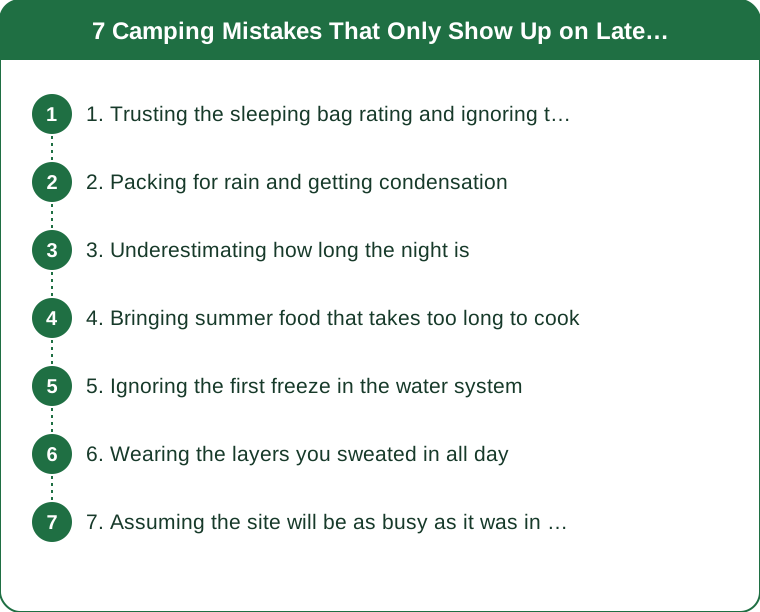
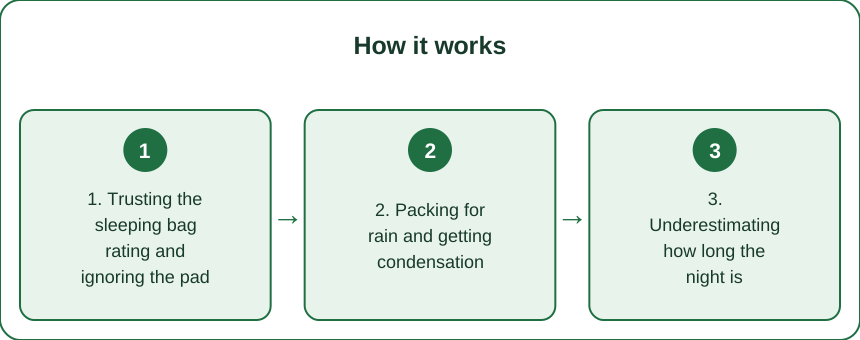
1. Trusting the sleeping bag rating and ignoring the pad
The bag is not what keeps you warm from below. It cannot be — you are lying on it and compressed insulation has almost no insulating value.
The ground is what steals your heat in autumn, and the sleeping pad is your only defence against it. Pads are rated with an R-value, roughly 1 to 7. A summer pad at R-2 is entirely adequate on 65-degree ground. On 40-degree autumn ground it is not close, and you will be cold in a bag rated to 20 degrees while wondering what went wrong with an expensive bag.
Rough targets: R-2 for summer, R-3 to R-4 for autumn, R-5+ for winter.
The fastest and cheapest fix is stacking. A cheap closed-cell foam pad under your existing inflatable adds roughly R-2 for very little money and weight, and gives you a backup if the inflatable punctures.
Ground temperature also lags air temperature by weeks. Mid-October soil is still holding late-September conditions, which cuts both ways — early autumn ground is warmer than the air suggests, and late autumn ground stays cold well past the first mild spell.
2. Packing for rain and getting condensation
In summer, tent moisture comes from weather. In autumn, it comes from you.
A sleeping person releases roughly a pint of water overnight through breath and skin. In warm weather that vapour passes through the tent fabric and disperses. On a cold night, it hits the inner surface of a fly that is below the dew point and condenses. You wake to a wet tent under a clear sky.
Fixes, in order of effectiveness:
- Ventilate even when it is cold. Every vent open, both doors cracked. It feels counterintuitive and it is the single biggest factor.
- Pitch away from water and low ground. Cold air and moisture both pool in dips. A few feet of elevation makes a real difference.
- Do not cook or boil water inside. You are adding steam to an already saturated space.
- Keep wet gear in the vestibule, never the inner tent.
- Take a small cloth. Wiping the inner fly before bed and once overnight removes more water than any gadget.
3. Underestimating how long the night is
In mid-July, darkness lasts around seven hours. By late October it is nearer fourteen.
That is a fundamentally different trip. Seven extra hours of darkness is not a minor inconvenience, it is most of a day you have not planned for, and the standard summer camper’s evening plan of sit-by-the-fire-until-bed does not stretch that far.
What to actually pack:
- More light than feels necessary, plus spare batteries. Cold reduces battery capacity noticeably, often by 20 percent or more.
- A lantern as well as a head torch. Head torches are useless for a group and awful for cooking.
- Something to do. Cards, a book, a downloaded film. The trip where you have nothing to do from 6pm is the trip that ends early.
- A realistic arrival time. Pitching in the dark is the most common cause of a badly sited tent, which then causes problems two and five.
4. Bringing summer food that takes too long to cook
Cold changes the maths on cooking in three ways at once.
Fuel performance drops. Standard isobutane canisters lose pressure as temperature falls and can struggle badly below about 40 degrees. Keeping the canister in your jacket for ten minutes before use is the standard trick and it works.
Boil times go up. Colder water, colder air, more wind. A two-minute boil in July can be five in October.
Your willingness to stand outside cooking goes down. This is the one nobody plans for. The elaborate meal you would happily make in August becomes intolerable at 42 degrees in the wind, and the fallback is a cold sandwich and an early bedtime.
Plan for one-pot meals with short cook times. Things that rehydrate rather than simmer. A thermos of soup prepared at home covers the arrival evening, which is when you are coldest and least organised. Bring more calories than summer generally — staying warm has a real metabolic cost and appetite runs higher.
5. Ignoring the first freeze in the water system
This one arrives with no warning on a night that was forecast at 34 degrees.
Water filters are the expensive casualty. Most hollow-fibre filters are permanently destroyed by freezing — the ice fractures the fibres, and you cannot see the damage, which means you keep using a filter that no longer filters. Sleep with the filter inside your sleeping bag on any night that could reach freezing.
Hydration bladder hoses freeze before the reservoir does. Blow the water back into the reservoir after each drink.
Bottles left outside freeze from the top. Store them upside down and the ice forms at the base, leaving the mouth clear.
Wet gear left out freezes solid. Boots in particular. Bring them inside the tent, or you will spend twenty minutes in the morning forcing frozen leather.
6. Wearing the layers you sweated in all day
The single most common cause of a genuinely cold night, and it is entirely avoidable.
Damp clothing conducts heat away from you roughly 25 times faster than dry clothing. A base layer that feels merely slightly damp after a day of hiking will keep you cold all night, no matter how good the bag is.
Change completely before getting into the bag. A dedicated set of sleep clothes that never leave the stuff sack and never get worn during the day. Dry socks, dry base layer, dry hat.
Change before you cool down, not after. As soon as you stop moving is the window. Once you are cold, you no longer have the surplus heat needed to warm the new layers up.
A hat matters more than you think in a tent. Not because of the old myth about heat loss through the head, but because your head is the one part outside the bag.
Do not overdress inside the bag. Compressing the insulation with too many layers reduces loft and makes you colder. One dry base layer plus the bag beats three layers plus the bag.
7. Assuming the site will be as busy as it was in August
Late-season sites empty out, and that changes the trip’s risk profile in ways people do not anticipate.
Facilities close. Water taps get shut off before the first freeze, toilet blocks close, and camp shops go to weekend-only hours. Check directly rather than assuming, because websites are frequently out of date.
There may be nobody nearby. In August a problem means walking to the next pitch. In late October you may be genuinely alone, which raises the stakes on a twisted ankle considerably. Tell someone your plan and your expected return.
Roads and tracks may be gated. Seasonal access roads close on fixed dates regardless of conditions, and finding a locked gate on the way out is a memorable way to end a trip.
Wildlife behaviour changes. Animals are feeding heavily before winter and are more active around food. Standard food storage discipline matters more in autumn than in midsummer.
The upside is real, though — empty sites, no bugs, better light, and the best sleeping temperatures of the year. Late-season camping is genuinely the best camping, provided you fix the five things above before you go rather than discovering them at 2am.
Late-Season Camping Questions, Answered
What temperature is too cold for a summer sleeping bag?
Treat the comfort rating rather than the limit rating as your real number, and add about 10 degrees of margin if you sleep cold. A bag rated comfort-40 is a genuine 50-degree bag for most people, and a liner adds roughly 5 to 10 degrees for very little weight.
Is a four-season tent necessary for autumn?
Almost never. Three-season tents handle autumn fine. Pad R-value and dry sleep clothes will improve your night far more than a tent upgrade will.
How much extra water should I carry if taps are off?
Plan on around a gallon per person per day for drinking and cooking combined, and confirm the nearest working source before you leave rather than after you arrive.
TL;DR:
- Sleeping pad R-value, not bag rating, is what fails first in autumn
- Autumn tent moisture is condensation from your own breath — ventilate more, not less
- Nights are twice as long as July’s, so plan light, batteries, and something to do
- Cold cuts fuel performance and your patience for cooking, so pick short one-pot meals
- Protect the water filter from freezing or replace it
- Change into completely dry sleep clothes before you cool down
- Confirm facilities and access, because sites shut down earlier than you expect
Fix these seven and late season becomes the best camping of the year — no bugs, no crowds, and the kind of cold clear nights that summer never delivers.
Keep Reading
This article is for general informational and styling purposes only. Fit, sizing, and product availability may vary.