7 Camping Mistakes That Turn a First Trip Into a Miserable One
Quick Answer: The most common first-trip camping mistakes are underestimating nighttime temperature, packing too much gear and too little food prep, and setting up camp after dark. Fixing just the temperature and daylight mistakes prevents most of the misery beginners report.
Your first camping trip doesn’t go wrong because of one dramatic disaster — it usually goes wrong through a string of small, avoidable mistakes that compound by hour three. Here are the 7 that come up most, in the order they tend to bite beginners.
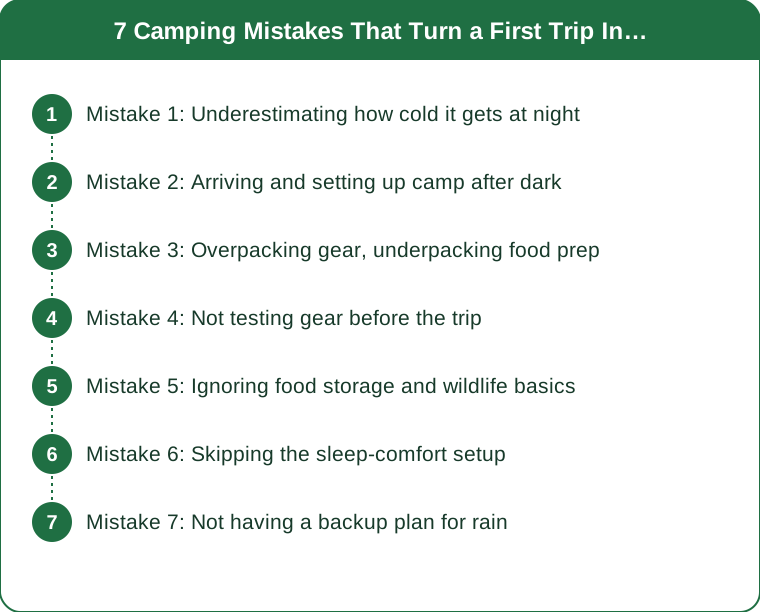
Mistake 1: Underestimating how cold it gets at night
Nighttime temperatures at a campsite can run 15-20 degrees colder than the daytime forecast you checked, especially near water or at elevation. Pack a sleeping bag rated at least 10 degrees below the coldest overnight low you expect, not the daytime high — this single miscalculation is behind more miserable, sleepless first nights than any gear failure.
Check the specific overnight low for your exact campsite location and elevation, not just the nearest town’s general forecast — a site 1,000 feet higher or closer to a river can run noticeably colder than the number that shows up on a basic weather app search.
Mistake 2: Arriving and setting up camp after dark
Setting up a tent, a camp kitchen, and a sleeping area in headlamp light takes roughly twice as long as doing it in daylight, and mistakes made in the dark (a poorly staked tent, a missed tent-rain-fly step) are the ones that cause problems at 2am. Aim to arrive with at least 2 hours of daylight left to set up.
Build in a buffer beyond your estimated drive time — traffic, a wrong turn on unmarked forest roads, or a bathroom stop can easily eat the daylight margin you planned for, and the campsite you’re heading to may have worse cell signal for navigation help than you expect.
Mistake 3: Overpacking gear, underpacking food prep
First-timers often pack a full duffel of “just in case” gear but plan meals loosely, assuming they’ll figure out cooking on-site. Prep and pre-portion every meal at home into labeled bags before you leave — camp cooking is dramatically easier when ingredients are already measured and you’re not improvising a recipe over a camp stove.
A simple system: one labeled gallon bag per meal, with every ingredient for that meal inside it, in the order you’ll use them. This turns dinner into an assembly task rather than a recipe you’re mentally reconstructing at a picnic table with cold hands and a headlamp.
Mistake 4: Not testing gear before the trip
A tent that’s never been set up, or a stove that’s never been lit, at home is a genuine risk at a campsite — missing poles, dead batteries, or an empty fuel canister are common and easy to catch with one test run in the backyard a few days before leaving.
This matters even for brand-new gear straight from the store — missing parts and manufacturing defects do happen, and finding out in your own backyard costs you nothing, while finding out at the campsite can cost you the whole trip.
Mistake 5: Ignoring food storage and wildlife basics
Food left in a tent or an unsealed cooler is the single biggest reason campsites attract unwanted animal visitors overnight. Store all food and scented items (toothpaste, deodorant) in a sealed container in your car trunk or a bear-proof locker where available — not just zipped in a tent pocket.
Mistake 6: Skipping the sleep-comfort setup
A sleeping bag on bare ground loses a significant amount of body heat to the cold earth beneath you, regardless of how warm the bag is rated. A sleeping pad with an R-value of at least 3 for cool-weather trips matters as much as the bag itself, and it’s the detail beginners skip most often to save pack space.
Mistake 7: Not having a backup plan for rain
Rain turns an unprepared campsite miserable fast — a wet tent floor, soaked firewood, and nowhere dry to cook. Pack a tarp for a rain shelter over the cooking area and store firewood under cover from the moment you arrive, even if the forecast looks clear, since mountain and forest weather can shift with little warning.
FAQ: First-Time Camping Questions, Answered
What temperature sleeping bag do I need for camping?
Rate your bag at least 10 degrees below the coldest overnight low you expect at your specific location, not the general season average — mountain and near-water sites run notably colder than town forecasts suggest.
How much food should I pack per person per day?
A common baseline is roughly 1.5-2 pounds of food per person per day for active outdoor days, pre-portioned into meals rather than packed as loose ingredients to sort out at the site.
Is it safe to camp alone as a woman for the first time?
Many women camp solo safely by choosing well-reviewed, established campgrounds for a first trip, sharing their itinerary with someone at home, and building confidence at busier sites before trying more remote ones.
TL;DR:
- Nighttime temps run 15-20 degrees colder than daytime forecasts — pack your sleeping bag accordingly
- Arrive with 2+ hours of daylight left to set up camp properly
- Pre-portion meals at home; test all gear in the backyard before you leave
- Store food sealed away from your tent, and pack a rain contingency even under a clear forecast
Run through these 7 before you pack the car — fixing even the temperature and daylight mistakes alone prevents most of what makes a first trip miserable.
Keep Reading
This article is for general informational and styling purposes only. Fit, sizing, and product availability may vary.