7 Late-Summer Camping Mistakes That Cost You a Night's Sleep
Quick Answer: Late-summer camping fails in predictable ways: packing for the daytime temperature and freezing at 4am, misjudging how much earlier it gets dark, and waking up in a tent wet with condensation rather than rain. The fixes are a sleeping pad with adequate insulation, a head torch you actually planned around, and ventilation that stays open all night.
The conditions in late August and September are genuinely excellent for camping - fewer insects, fewer crowds, comfortable days. They also produce a specific set of avoidable problems.
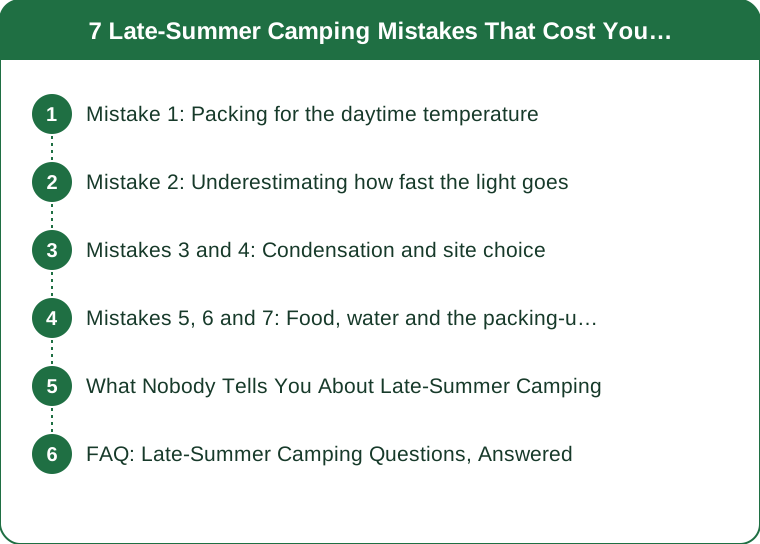
Mistake 1: Packing for the daytime temperature
The single most common late-summer camping error, and the one that costs the most sleep.
The daily temperature range widens dramatically in late summer. A 26-degree afternoon can drop to 8 degrees before dawn - a swing of nearly 20 degrees. In midsummer the same location might only drop to 15.
Why it catches people out: you pack while it is warm, you arrive while it is warm, and you set up camp while it is warm. The decision is made at every point except the one that matters.
What actually keeps you warm at night, in order of importance:
- The sleeping pad, not the sleeping bag. Ground conducts heat away from you far faster than air does. A summer-weight bag on an insulated pad beats a warm bag on a thin foam mat, and this surprises people every time. Look for the R-value - roughly 2 to 3 for late summer, 4 or above for genuine cold.
- A hat. Simple, light, and disproportionately effective.
- Dry base layers kept exclusively for sleeping, never worn during the day. Slightly damp clothing is why people are cold in an adequate bag.
- The bag itself, which most people over-prioritise
A useful rule: check the overnight low forecast and subtract three to five degrees for valley bottoms and open ground, where cold air pools. Then pack for that number, not for the day.
Mistake 2: Underestimating how fast the light goes
In late August, daylight is shortening by two to three minutes per day in mid-latitudes - and it compounds fast.
By early September you have lost well over an hour of evening light compared to the solstice, and dusk arrives faster because the sun’s angle at setting is steeper than in midsummer.
The practical consequences:
- Arriving at 7pm feels fine and is actually tight. Pitching in the dark on unfamiliar ground is where most gear gets lost or broken.
- Cooking becomes a head-torch activity much earlier than expected
- The evening is longer, which is genuinely pleasant if you planned for it and grim if you did not
What to plan around:
- Check actual sunset time for your location and date, rather than assuming - it can be 45 minutes earlier than the last trip a month ago
- Aim to be pitched at least 90 minutes before sunset
- Head torch per person, not per group, plus a spare set of batteries. A shared torch is a shared argument.
- A lantern or diffused light for the cooking area - a head torch pointed at a pan blinds everyone else
The upside worth planning for: darker skies arrive at a sociable hour. Late August and September are excellent for stargazing without staying up until midnight, and the Perseids tail off through late August.
Mistakes 3 and 4: Condensation and site choice
Mistake 3: Assuming a wet tent interior means a leak.
It almost never does. It is condensation, and late summer is peak season for it.
Why it happens: a sleeping adult exhales and perspires a substantial volume of water vapour overnight - often several hundred millilitres. When that warm moist air meets a cold tent wall, it condenses. Cool clear nights, which are exactly what late summer produces, create the biggest temperature differential and therefore the most condensation.
How to reduce it:
- Ventilate, even when it is cold. Closing every vent to stay warm is what causes the problem. Open vents at both ends to create airflow.
- Pitch away from water and low ground, where humidity is highest and cold air collects
- Do not cook inside the tent - it adds significant moisture, alongside the more serious carbon monoxide risk
- Keep wet kit in the porch, not the inner
- Shake the flysheet out in the morning before packing, and dry it properly at home within a day
Mistake 4: Choosing a site by the view rather than the ground.
- Cold air flows downhill and pools. A pitch at the bottom of a slope can be several degrees colder than one partway up.
- Slightly raised ground stays drier and drains if it rains
- Check what is overhead - dead branches are a genuine hazard, and the term for them in camping circles is unambiguous
- Morning sun matters in late summer. A pitch that catches early sun dries the tent and makes the morning far more pleasant; a north-facing pitch stays damp until midday.
- Consider wind direction for both the tent door and the cooking area
Mistakes 5, 6 and 7: Food, water and the packing-up problem
Mistake 5: Treating food storage as a summer problem only.
Wildlife activity often increases in late summer and autumn as animals build reserves. Food left accessible is more likely to attract attention in September than in June, not less.
- Store food sealed and away from the sleeping area, in a vehicle or a hung bag where required
- Cook and eat away from where you sleep, ideally some distance downwind
- Take all waste out. Late-season sites see more scavenging.
Mistake 6: Assuming water sources are as reliable as in spring.
- Streams and springs run low or dry by late summer after a dry season
- Do not plan a route around a water source you have not confirmed recently
- Carry more than you think for the first day, and treat any natural water regardless of how clear it looks
Mistake 7: Packing a wet tent and forgetting about it.
This is the mistake with the longest tail, because the consequence arrives weeks later.
- A tent packed damp will develop mildew within days, and mildew permanently damages the waterproof coating and smells indefinitely
- If you must pack wet, unpack and dry within 24 hours without exception
- Dry it fully - inner, fly and groundsheet - before storing. Store loosely rather than tightly compressed.
- Late summer condensation means your tent is probably damp even when it has not rained, which is exactly why this mistake is so common in this season
The pattern across all seven: late summer looks like easy camping and quietly demands the preparation of shoulder-season camping. Warm days, cold nights, short evenings, and heavy dew.
What Nobody Tells You About Late-Summer Camping
Dew is heavier than at any other time of year. Clear nights and warm ground produce dew that soaks everything left outside. Anything you want dry in the morning goes in the porch, including boots, which are miserable to put on wet.
Insects change rather than disappear. Mosquito numbers drop, wasps rise sharply - and wasps in late summer are attracted to sweet food and drink. Cover open drinks, particularly cans, where a wasp can get inside unnoticed.
Your summer sleeping bag is probably rated optimistically. Comfort ratings and limit ratings are different numbers, and the number on the label is often the limit - survivable rather than comfortable. For late summer, look at the comfort rating and treat it as the honest one.
Ground temperature lags air temperature by weeks. In late August the ground is still holding summer heat, which is why late-summer camping is warmer than a spring trip at the same air temperature. By late September that advantage is gone.
Campsites empty out after the school term starts, and the difference is dramatic. The first week of September is one of the best camping windows of the year - warm ground, quiet sites, no midges, and availability at places that were booked solid in July.
A power bank matters more than it used to. Cold overnight temperatures drain phone batteries faster, and a phone at 4 percent is a navigation and safety issue rather than an inconvenience. Keep the phone in the sleeping bag overnight - it genuinely preserves charge.
FAQ: Late-Summer Camping Questions, Answered
Why is the inside of my tent wet when it did not rain?
Condensation. A sleeping adult releases a lot of moisture overnight, and it condenses on cold tent walls. Ventilate at both ends, even when it feels cold.
What matters more, the sleeping bag or the sleeping pad?
The pad, in most cases. Ground conducts heat away far faster than air, so an insulated pad with an adequate R-value does more than upgrading the bag.
How much colder does it get at night in late summer?
The daily range widens considerably - a 20-degree swing between afternoon and pre-dawn is common. Check the overnight low and subtract a few degrees for valley pitches.
Is September a good time to camp?
Often the best of the year - warm ground, quiet sites, few insects. The tradeoffs are shorter evenings, heavy dew, and colder nights.
What is the most common gear failure?
Packing a damp tent and leaving it. Mildew develops within days, damages the coating permanently, and late-summer condensation means the tent is usually damp even without rain.
TL;DR:
- Pack for the overnight low, not the afternoon high - the daily range widens sharply in late summer
- The sleeping pad’s insulation matters more than the bag’s rating
- Wet tent interiors are condensation, not leaks - ventilate at both ends all night
- Be pitched 90 minutes before sunset, and check the actual sunset time rather than assuming
- Never store a tent damp; mildew develops within days and ruins the coating permanently
Late summer is genuinely one of the best camping windows there is. It just asks for shoulder-season preparation dressed up as easy summer weather.
Keep Reading
This article is for general informational and styling purposes only. Fit, sizing, and product availability may vary.